

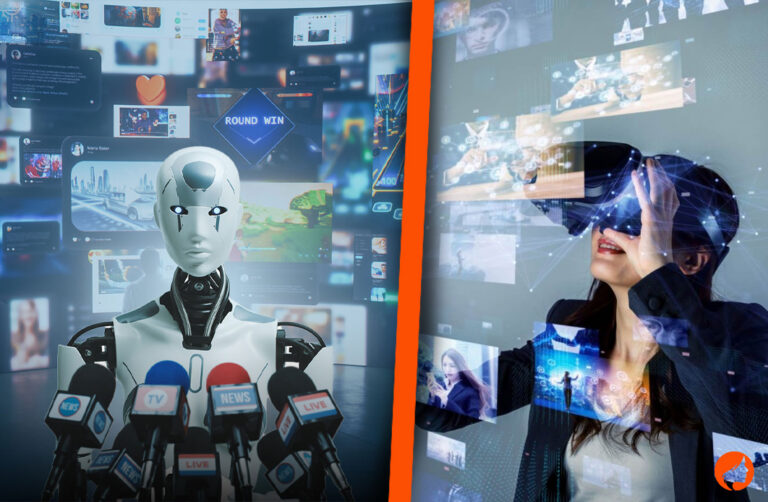
The overall global market for AI in media and entertainment is projected to surge from its 2025 value (billions) to nearly USD 99.48 billion by 2030, reflecting a robust compound annual growth rate.
The landscape of media and content creation is undergoing a seismic shift in 2026, driven primarily by the revolutionary capabilities of AI in media. As machine learning algorithms and natural language processing continue to evolve, media companies are adopting advanced artificial intelligence solutions to optimize production, streamline workflows, and enhance audience engagement.
For businesses seeking to stay competitive, understanding these AI-driven transformations is no longer optional; it’s imperative. From automated video editing to hyper-personalized content recommendations, artificial intelligence is redefining every stage of media creation.
1. Automated Video and Audio Editing
One of the most remarkable applications of AI in media is the automation of video and audio editing. Advanced AI algorithms can now identify the most engaging scenes, balance audio levels, and even correct visual inconsistencies with minimal human intervention. This not only accelerates post-production timelines but also ensures consistent quality, which is crucial for content platforms striving to maintain audience retention.
2. Intelligent Scriptwriting and Storyboarding
Natural language generation (NLG) models have enabled AI to draft scripts and create storyboards that align with audience preferences. By analyzing engagement metrics, trending topics, and demographic data, AI in media tools can suggest plot developments, dialogue, and narrative pacing. This capability significantly reduces creative bottlenecks, empowering content creators to experiment with innovative storytelling techniques.
3. Personalized Content Recommendations
In an era of content saturation, delivering personalized media experiences is essential. AI-driven recommendation engines analyze user behavior to predict what content viewers are most likely to engage with. This not only increases consumption rates but also enhances customer satisfaction, making AI-powered personalization a core strategy for entertainment platforms.
4. Enhanced Visual Effects (VFX) and CGI
The integration of AI into VFX pipelines allows for real-time generation of complex visual effects, character modeling, and scene enhancement. Through deep learning and generative adversarial networks (GANs), AI in media can create hyper-realistic visuals that were previously time-consuming and costly. Consequently, production houses can achieve cinematic-quality effects with significantly reduced budgets.
5. Automated Localization and Translation
Global content distribution demands accurate localization, which traditionally required extensive human resources. AI now offers automated translation, voice-over, and subtitling solutions that maintain cultural context and tone. As a result, media companies can reach international audiences faster while ensuring linguistic accuracy, further broadening their market reach.
Over 60% of media companies plan to increase their investments in AI technologies in the near future.
6. Predictive Analytics for Content Strategy
Predictive analytics powered by AI allows media companies to anticipate trends, audience preferences, and potential engagement metrics. By analyzing historical data and real-time viewer behavior, AI in media helps decision-makers craft data-driven strategies that optimize content planning, reduce risks, and maximize ROI for both digital and traditional media channels.
7. Interactive and Immersive Media Experiences
With the rise of virtual reality (VR) and augmented reality (AR), AI plays a pivotal role in creating interactive experiences. AI algorithms generate dynamic environments and adaptive storytelling paths, making media content more engaging and personalized. For businesses looking to innovate, partnering with an entertainment app development company like 8ration can ensure the integration of AI-driven immersive experiences into their platforms.
8. Automated Content Moderation
Content moderation is critical to maintaining platform integrity and regulatory compliance. AI-powered moderation tools can automatically detect inappropriate, offensive, or copyright-infringing material. By leveraging machine learning models that continuously improve, media companies can reduce manual oversight while ensuring safe and compliant content delivery.
9. Enhanced Voice and Facial Synthesis
Generative AI models are transforming how media professionals approach voiceovers and digital avatars. AI can create realistic synthetic voices and facial expressions, enabling the production of lifelike characters and interactive assistants. This technology is increasingly vital for animated films, gaming, and personalized media experiences.
10. Efficient Workflow Automation
Finally, AI in media is revolutionizing content production by automating repetitive tasks, such as metadata tagging, scheduling, and performance reporting. These efficiencies free creative teams to focus on high-value activities, accelerating production cycles and reducing operational costs. Companies looking to integrate these solutions often collaborate with an AI app development company to implement custom AI workflows tailored to their specific needs.
AI is the defining technology of our time, empowering creators to imagine, innovate, and scale ideas faster than ever before. – Satya Nadella, CEO of Microsoft
Must Read: Tacoma Simmons: The Reserved Music Mind Carrying a Legendary Name
Final Thoughts!
In 2026, AI in media is no longer a futuristic concept, it is a transformative force redefining the content creation landscape. From intelligent editing and predictive analytics to immersive experiences and automated workflows, AI empowers media professionals to produce higher-quality, personalized content at unprecedented speeds.
As competition intensifies, embracing AI-driven innovations is essential for media organizations aiming to captivate audiences, optimize operations, and stay ahead in a rapidly evolving digital ecosystem.
