

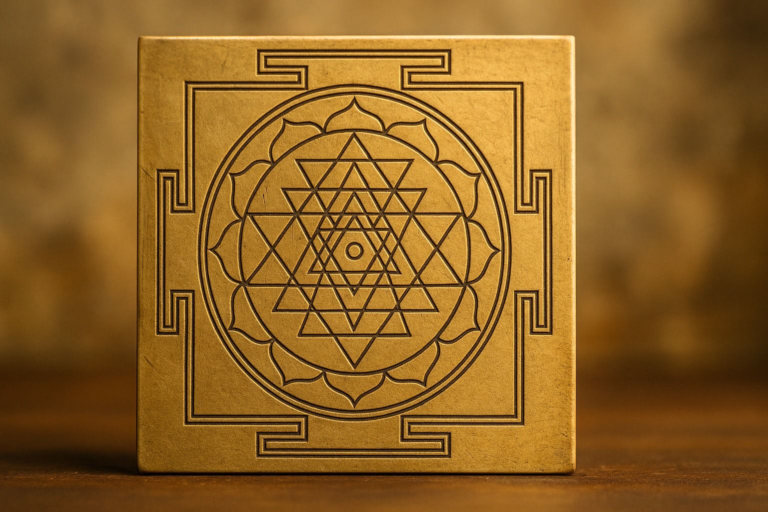
The Sri Yantra, the sacred geometric diagram composed of nine interlocking triangles radiating from a central point, represents far more than aesthetic spiritual art; it encodes principles of how consciousness organizes complexity, how multiple forces integrate into coherent wholeness, and how meditation practice can train the mind to hold paradox, perceive patterns, and navigate the intersection of opposing energies that characterizes transformational leadership. For contemporary leaders, founders, and visionaries navigating organizational complexity where masculine and feminine principles must balance, where strategic drive must integrate with receptive wisdom, and where multiple stakeholder perspectives must synthesize into coherent vision, the Sri Yantra provides contemplative technology for developing precisely these capacities. The geometric structure five downward-pointing triangles (Shakti, feminine creative energy) interpenetrating with four upward-pointing triangles (Shiva, masculine consciousness) mirrors the integration work required of those called to shape culture and systems: you must balance assertive action with receptive sensing, strategic planning with emergent responsiveness, and visionary clarity with grounded implementation. As explored in the teachings at Shams-Tabriz, authentic spiritual practice must enhance practical capacity for purpose fulfillment rather than becoming escape from developmental demands Sri Yantra meditation serves this integration when approached as training for consciousness that produces demonstrable enhancement in how you lead, decide, and create rather than becoming aesthetic spiritual bypassing divorced from measurable results.
The Structure: Understanding What You’re Working With
The Sri Yantra’s geometry contains specific elements each representing principles of consciousness organization: the central bindu (point) represents unified source from which all manifestation emerges; the nine interlocking triangles create 43 smaller triangles representing stages of creation and levels of reality; the three concentric circles symbolize past, present, future or body, mind, spirit; and the outer square with four gates represents the material world and protection. For meditation practice, this structure provides progressive focal points you’re not just staring at pretty geometry but training attention to move from periphery (external material reality) through layers of increasing subtlety toward center (unified consciousness), then back out again integrating realization with practical action. This mirrors the developmental arc required of transformational leaders: moving from surface-level problem-solving toward perceiving root patterns and systemic structures, then translating that deeper perception into strategic interventions that reshape material reality. The meditation isn’t about achieving mystical states but developing cognitive flexibility, sustained attention, and capacity to hold multiple perspectives simultaneously competencies directly applicable to complex decision-making and systems leadership.
The Practice Protocol: From Beginner to Advanced
Foundational Practice (Weeks 1-4): Boundary to Center
Begin by gazing at the outer square, allowing eyes to trace the four gates representing the four directions and material world. After 2-3 minutes, move attention inward to the circles, then to the outer triangles, progressively moving toward the central bindu over 15-20 minutes. Practice daily, documenting what you notice: Where does attention become unstable? Which geometric sections feel activating versus calming? Does the practice enhance or destabilize your capacity to function effectively in daily leadership? If meditation creates escape from practical demands rather than enhanced engagement with them, you’re using it as spiritual bypassing rather than developmental practice.
Intermediate Practice (Weeks 5-8): Paradox Training
Focus specifically on the interlocking triangles where upward and downward forces interpenetrate. Contemplate how opposing energies create stability rather than conflict masculine and feminine, expansion and contraction, vision and grounding. As you gaze, ask: Where in my leadership do I need better integration of opposites? Where am I over-identified with one polarity while rejecting its complement? The yantra trains you to see that wholeness requires both forces in dynamic tension, not victory of one over the other crucial insight for leaders who must balance competing values, integrate diverse stakeholder needs, or synthesize strategic clarity with operational flexibility.
Advanced Practice (Ongoing): Strategic Application
Use the Sri Yantra as contemplative preparation before major decisions or strategic planning. Gaze at the geometry for 10 minutes, allowing it to organize your consciousness toward pattern recognition and systems thinking, then immediately apply that state to the practical challenge at hand. Document whether yantra-informed decisions demonstrate enhanced quality greater integration of factors, fewer unintended consequences, more sustainable outcomes. If the practice doesn’t produce measurable improvement in strategic capacity, it’s aesthetic spirituality rather than developmental technology.
Practice Integration Framework:
| Practice Level | Duration | Focus | Leadership Capacity Developed | Verification Method |
| Foundation | 15-20 min daily | Outer to center attention training | Sustained focus, reduced reactivity | Track attention stability |
| Intermediate | 20-25 min daily | Paradox holding, polarity integration | Balancing opposites, systems thinking | Assess decision quality |
| Advanced | 10 min pre-decision | Strategic pattern recognition | Enhanced strategic clarity | Document outcome improvements |
| Mastery | As needed | Spontaneous integration | Embodied systems perception | Organizational effectiveness metrics |
Integration Imperative: From Practice to Embodied Capacity
Sri Yantra meditation serves transformational leadership only when it produces demonstrable enhancement of practical capacity not just interesting experiences but actual improvement in how you perceive complexity, integrate opposing forces, maintain attention under pressure, and translate vision into effective strategy. The measure of authentic practice is ruthlessly practical: Has your strategic thinking improved? Can you hold paradoxes more comfortably? Do others experience you as more integrated and less reactive? Are your organizations more coherent? Without these verifiable results, yantra meditation becomes spiritual consumerism collecting practices as identity markers rather than developing actual competencies your mission requires. Geometry itself teaches this principle: all complexity emerges from and returns to a unified source through disciplined integration, not through escape from material reality into transcendent states. For leaders standing at the threshold where inner development must meet outer impact, the Sri Yantra offers a training ground for the consciousness that can perceive patterns, integrate polarity, and organize complexity into coherent systems serving collective evolution.
Must Read: How Long Soft Tissue Injuries Last After a Car Accident
