

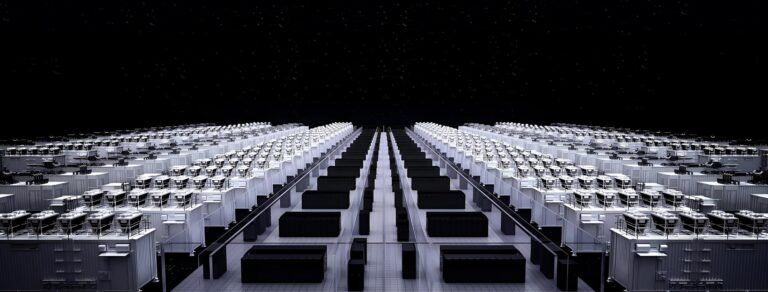
Illustrative view of equipment used in ؼ projects.
A data center is more than a server room. A data center facility combines electrical supply, cooling, IT space, fire protection, monitoring, security, and operations into an environment that must support continuous digital services. Project planning is easier when the main operating requirement is clear from the beginning. Good procurement balances present requirements with realistic future demand, without paying for capacity that has no defined use. The central design task is to connect the selected equipment with a clear site requirement.
Coordinate security with remote management
Connected monitoring can improve visibility, but access to facility controls must be governed carefully. Network segmentation, role-based permissions, secure remote access, audit logs, and change approval help reduce operational risk. Security design should include vendors and service partners without granting broader access than their tasks require.
Allow the infrastructure to follow hardware evolution
Accelerator generations and server configurations can change faster than building infrastructure. The facility plan should identify which elements can be expanded or reconfigured and which would require major construction. Reserved electrical capacity, cooling interfaces, floor loading, and cable pathways should be based on a documented growth scenario. For a closer look at the solution scope, review data center facility and consider how its documented functions fit the site layout, electrical interfaces, and operating plan.
Bring operations into the design review
The people who will operate and maintain the installation should review the design before procurement is complete. They can identify access problems, unclear alarms, difficult isolation steps, or spare parts that may be hard to obtain. Their input often reveals lifecycle issues that are not obvious from a product datasheet.
Design the full power path
The power path extends from the utility connection through transformers, switchgear, UPS systems, distribution, and rack-level equipment. Each stage has a capacity, efficiency, protection, and maintenance requirement. A single-line diagram should show normal and alternate paths, common points of failure, and the effect of taking any major component out of service. Performance should always be assessed against the actual installation conditions and the complete system boundary.
Start with the IT load profile
AI computing workloads can create dense and rapidly changing electrical demand. Facility planning should therefore use realistic rack-level power assumptions, deployment phases, and workload growth scenarios rather than relying only on an average room load. The electrical and cooling design needs to reflect both steady-state demand and the transitions that occur as computing clusters start, stop, or scale. A project specification for data center facility should identify the applicable configuration, installation limits, commissioning checks, and service responsibilities.
Build reliability across products and architecture
AIDC availability depends on the quality of individual components and the way the system is arranged. Redundant paths, isolation of fault domains, backup power, monitoring, and maintenance procedures need to be considered together. Redundancy labels alone do not prove resilience if two nominally separate paths share a common upstream dependency.
Must Read: How to evaluate C&I Solar for real-world infrastructure
