

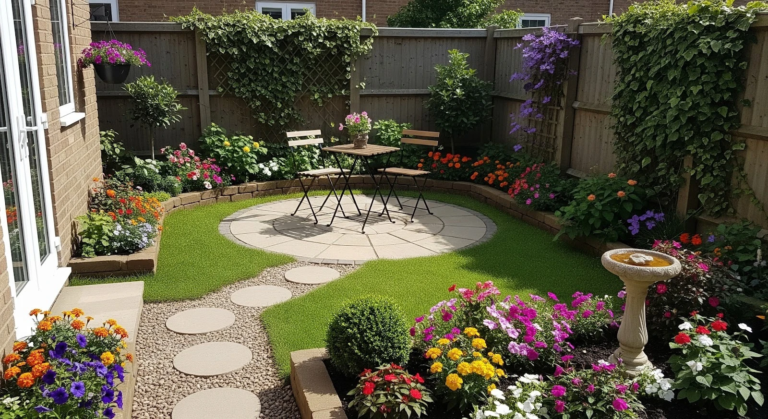
Even a small backyard can be a home away from home or a cramped appendix and the distinction is usually in the layout, rather than square feet. With a little visual magic and a few practical real-world elements (traffic, seating, storage, lighting) in planning the space, even a small outdoor area will appear open, welcoming, and surprisingly adaptable.
The idea is not to cram more into the yard. It is to facilitate the travel of the eye and visual decongestion, allowing areas to be purposeful so the space reads as intentional, as opposed to cramped.
Optimize Traffic Flow: Creating a Functional Outdoor Floor Plan
The simplest solution to creating the illusion of a larger backyard is to cease utilizing it as a left-over bit of outdoor space and begin using it as an outdoor room. This implies that you will want a straightforward circulation route an easy path that people tend to follow when they pass through the door to the seat, to the grill, to the garden, and so on.
Make a scribble of a plan and indicate on it where people walk now. When you encounter bottlenecks, such as the one between a chair and a planter, correcting it immediately can help free up the area; you will instantly create more space simply because movement becomes easy.
A design tip: keep major walking paths open, and only marginally wider than you think you need. Individuals should be able to walk their path without having to turn sideways, which prevents the entire backyard from feeling overcrowded.
Zoning Small Spaces: Creating Distinct Outdoor Living Areas
Zoning is something that only big backyards can do, right? Wrong it is a small space superpower. Rather than one all-purpose space, strive to have two or three functional areas, such as a small lounge, a dining area, and a green corner. With a distinct role assigned to every zone, the space itself will look larger, and your mind will interpret it that way.
The trick is in drawing divisions between zones. Use a change of texture (gravel vs. decking), the edge of a low planter, an outdoor rug, or a thin bench that delimits a space without obstructing sightlines. Tall dividers also work, but in a small yard, they must be open consider open slats or a trellis, not a solid wall.
Unified Hardscaping: Flooring Ideas to Create Continuity
An uneven combination of surfaces, such as patchy and mismatched tiles or patchwork pavers, can cause a visual contraction of a yard because your eye keeps halting. The continuity of the ground plane makes it all seem like one unit, and unity is perceived as spaciousness.
Provided you already possess an older slab or worn patio, Spraycrete surfacing may be a viable solution for providing a fresher look without completely removing the existing surface, particularly when you desire a cleaner look that links different areas together. If you have several textures (like a dining pad and a garden path), keep the same color palette so that the whole yard will give the impression of a single large outdoor room.
Space-Saving Furniture: Choosing Multi-Purpose Pieces
Oversized patio furniture is the most frequent reason a small backyard seems cramped. In place of a huge sectional, try a loveseat and two small chairs, or a bench with portable side tables. You’ll create spaciousness and flexibility always makes a room feel larger since it can adapt to the occasion.
Find items that can perform more than one function:
- Benches that store cushions and gardening tools.
- Nesting tables that can be expanded upon the arrival of guests.
- Portable dining tables that can be folded away during quiet days.
- One statement chair rather than several large chairs.
In addition, choose furniture with open legs when you have the chance. Seating raised above the ground looks less bulky since you can see more of the floor surface beneath it. If your outdoor activities are based on cooking and entertaining, a compact outdoor kitchen design is helpful, especially when made to look like a streamlined wall or L-shape instead of a huge island.
Landscape Lighting: How to Add Depth and Dimension at Night
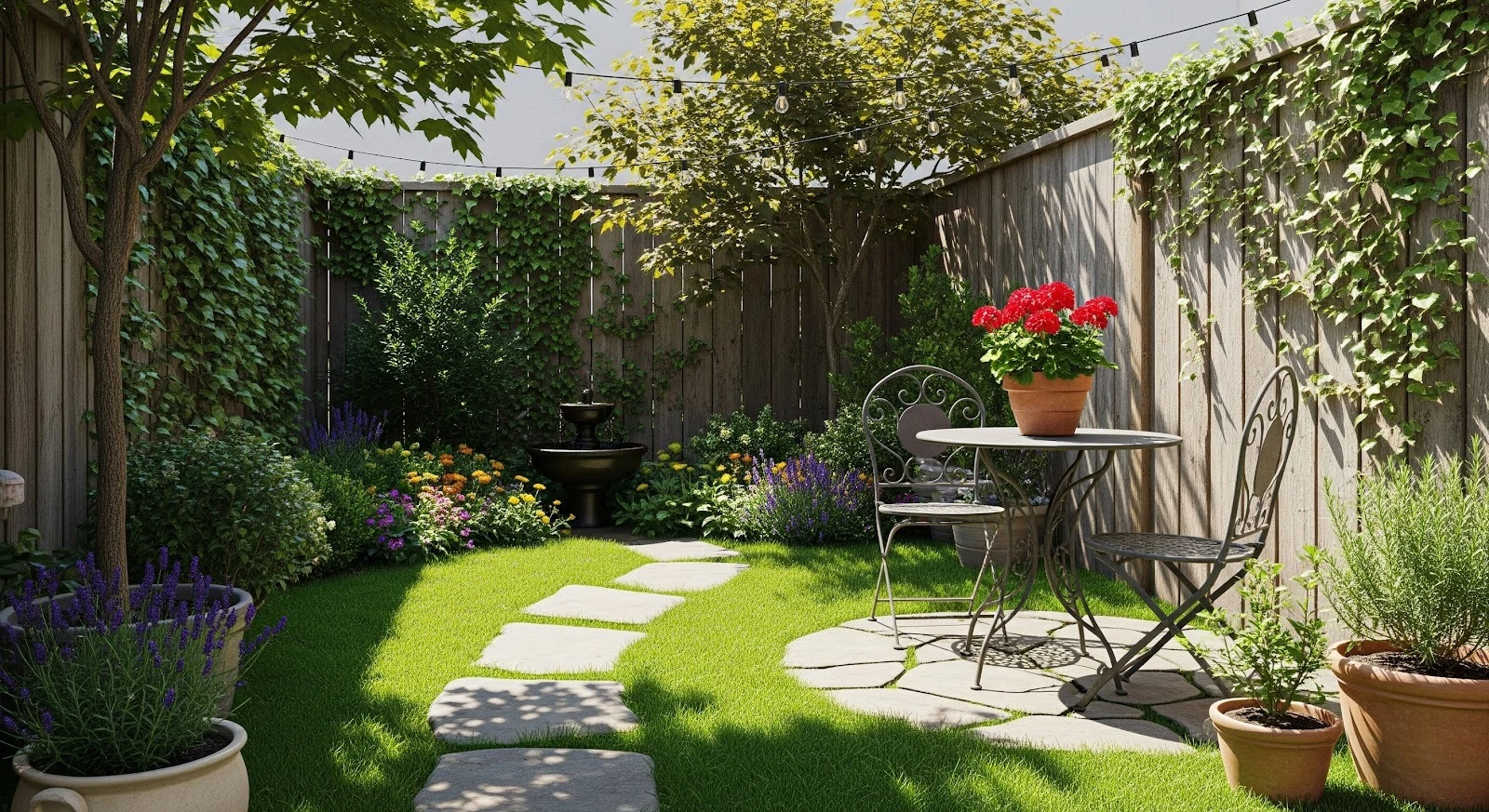
Small backyards are often most impressive during the evening hours, provided the lighting is carefully considered. It is not about being bright everywhere; it is about textured light which creates depth. The yard becomes more dimensional when you create highlights and shadows.
Try layering like this:
- Soft ambient light (string lights or warm wall lights).
- Task lighting (near grilling areas, dining tables, steps).
- Accent lighting (a light on a plant, a spotlight on a feature).
Even a few solar path lights can assist in defining edges and making the perimeter appear more distant, which indirectly increases the apparent size.
Minimalist Design: Curating a Simple Material and Color Palette
A small yard can quickly get cluttered when you combine excess colors, patterns, and finishes. The use of two primary materials, plus one accent, generates a sense of tranquility. Calm reads as spacious.
For illustration, you may opt to have a single main hardscape color (warm gray or sandy beige), one wood color (natural or dark), and an accent color (sage green, terracotta, or navy) via cushions and pots. Repetition of finishes provides rhythm, and rhythm makes the space seem bigger as it appears cohesive.
Quick Wins for a Spacious, Relaxing Backyard
Even a small backyard does not require big gestures, just clever decisions. By focusing on flow, creating a few lightweight zones, simplifying your palette, and including one powerful focal point, you will experience the yard as bigger because it will work better and feel calmer.
Even if you don’t have a full refresh on the agenda, identify just one thing you can accomplish over the weekend (purging the yard and organizing the seating is an excellent place to start) and start with that. You will not regret it the next time you step outside.
Must Read: How Technology Is Speeding Up Home Sales
